Paul Polson was born and raised in Wyoming, where the geological world around him — its layered rock, stacked sediment, and visible time — became the conceptual core of a painting practice that has continued for more than fifty years. He received his BA in Art Education from the University of Wyoming in 1970, then moved to San Diego, where he spent fifteen years as a studio artist, organized figure drawing classes, and did graduate work at San Diego State and the University of California San Diego. In 1982 he entered the inflatable sculpture industry, and by 1983 found himself at the center of a large-scale public art commission — an inflatable King Kong for the Empire State Building marking the film’s 50th anniversary.
That opened two decades of work building giant inflatable sculptures and scenic sets through his company Big Air Productions, Inc., with clients including Cirque du Soleil, Radio City, the Broadway production of Cats, the Macy’s Day Parade, and Disney. In 1988 he moved to Pioneer Square in Seattle, painted in a warehouse for three years, then relocated to Poulsbo and the Kitsap Peninsula, where he lived and worked for over twenty years. In 2018 he settled in Astoria, Oregon, arriving and a desire for a fresh landscape.
He found it on the Oregon coast. His ongoing Strata series — begun in Wyoming and developed across every place he has lived — treats landscape as geological cross-section: stacked histories, core samples of human existence over time, the deep record of place made visible in paint. His brushstroke has a “staccato rhythm,” alternating thick and thin applications for a tactile surface that holds both the geological weight of the concept and the immediacy of direct observation.
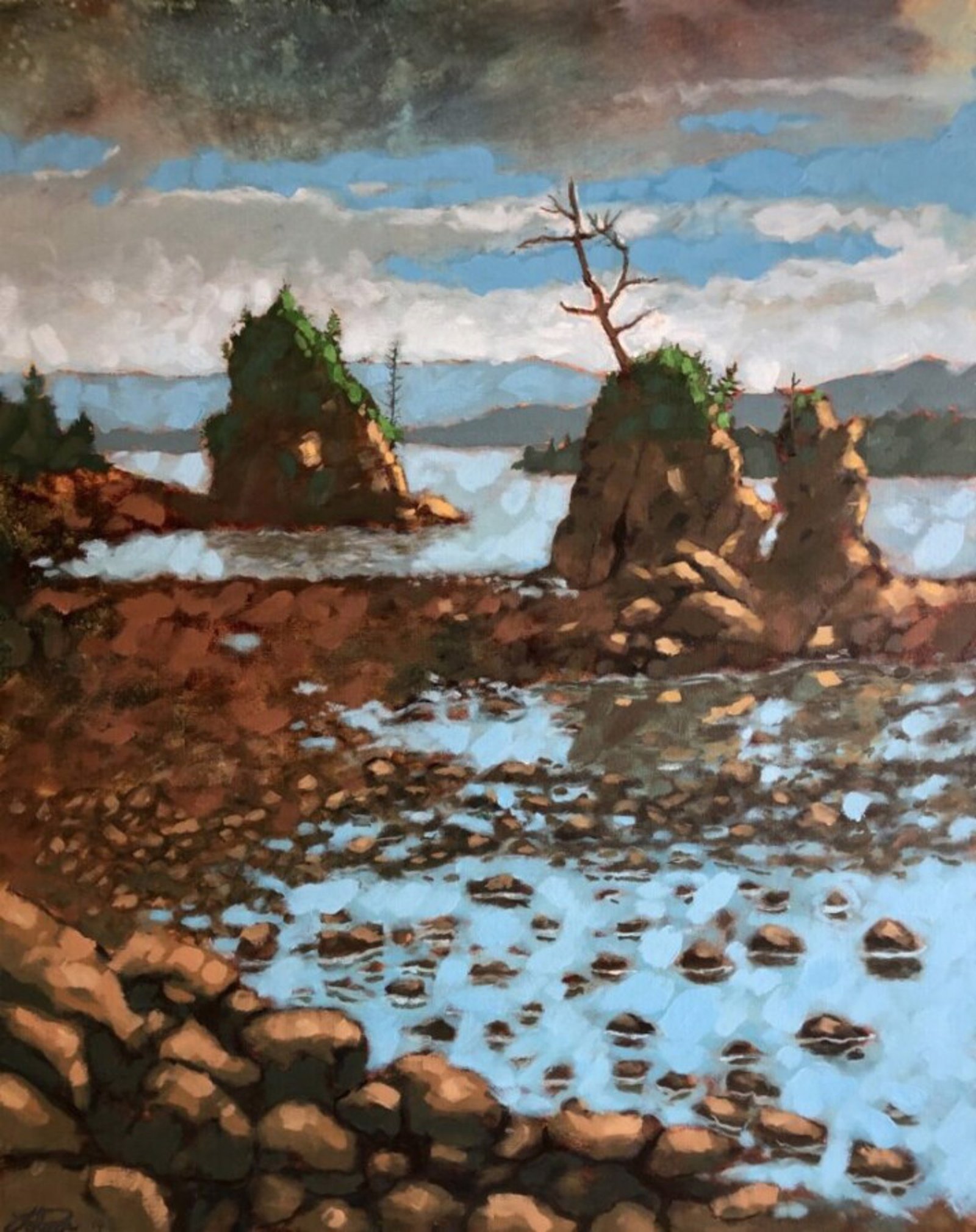
In Three Sisters’ Oregon Coast, The composition divides sharply at the horizon line, with raw sienna and burnt umber dominating the rocky foreground while cerulean and white clouds occupy nearly two-thirds of the canvas above. Three isolated rock stacks, their shadowed faces rendered in umber and olive, rise from a shallow tidal flat where individual stones are rendered with deliberate flatness—the paint applied in discrete patches rather than modeled, creating a patchwork effect that fights against atmospheric recession. A dead tree with spindly branches crowns the central stack like a skeletal afterthought, while the distant lake and mountains recede into cooler greens and grays.
Paul's work is shown across both Bainbridge and Park City. Browse the full collection — medium, dimensions, and price visible on every piece.